
Independent guidance · Survey guides
Asbestos Sampling
Targeted bulk sampling of one or more suspect materials by an accredited surveyor — costs, turnaround and reading the result.
Key takeaways
- Lab analysis only: £30–£85 per sample
- Our surveyor visit: one sample £85 + VAT; two samples £115 + VAT
- Each additional sample at same visit: £30 + VAT
- Same-day analysis premium: £85–£120 per sample
- Standard turnaround: 24–72 hours from receipt at lab
Independent consultancy view of how the survey should actually be commissioned and read. Bulk sampling is the targeted service that answers a single question: does this specific material contain asbestos? It is appropriate where a homeowner has found a suspect material during DIY, where a contractor needs confirmation before quoting work, where a survey has identified an item that warrants confirmation rather than presumption, or where a planning or conveyancing matter has flagged a specific item. Sampling is the cheapest decision-grade evidence you can buy in the asbestos market and the route most likely to be misused if the wrong person takes the sample, the wrong lab analyses it, or the result is read out of context. This guide covers how it works, what it costs in 2026, the law, and how to read the certificate the lab issues.
When sampling is the right tool
Sampling is the right service where a single material, or a small handful of materials, needs definitive identification and a full management or refurbishment survey is disproportionate. Typical use cases: a homeowner has lifted a carpet and found vinyl tiles that look suspect; a builder has chipped at an Artex ceiling and wants confirmation before quoting removal; a tenant has been told the airing cupboard lining is AIB and wants laboratory proof; a buyer's surveyor has flagged the garage roof and the seller wants a certificate to hand over. Sampling is not the right service for a whole building, for a refurbishment project, or for a regulatory survey under CAR 2012 — those need a proper survey with full scope.
What this means
Sampling answers a yes/no question about one material. It is not a substitute for a survey when a survey is what the duty requires.
Who is allowed to take the sample
The sampler must be competent. BOHS P402 (Building Surveys and Bulk Sampling for Asbestos) is the standard qualification and is what every accredited surveying firm will hold. The act of taking a sample is itself a fibre-release event and must be controlled: damped tools to suppress dust, small representative cut, sealed in a double bag, labelled with location, date, sampler and a unique reference. Most UKAS 17025 laboratories will only accept samples from competent persons because the chain of custody and the controlled-sampling conditions are part of the test's validity. DIY sampling — homeowners bagging up a chunk and posting it — is technically possible but most labs decline it and the exposure risk is real.
What this means
Pay £85 + VAT for a P402-qualified sampler to take one sample, including analysis; two samples are £115 + VAT and each further sample during the same attendance is £30 + VAT. The cost of doing it badly yourself includes both your own exposure and a result the lab may not accept.
How the lab actually analyses it
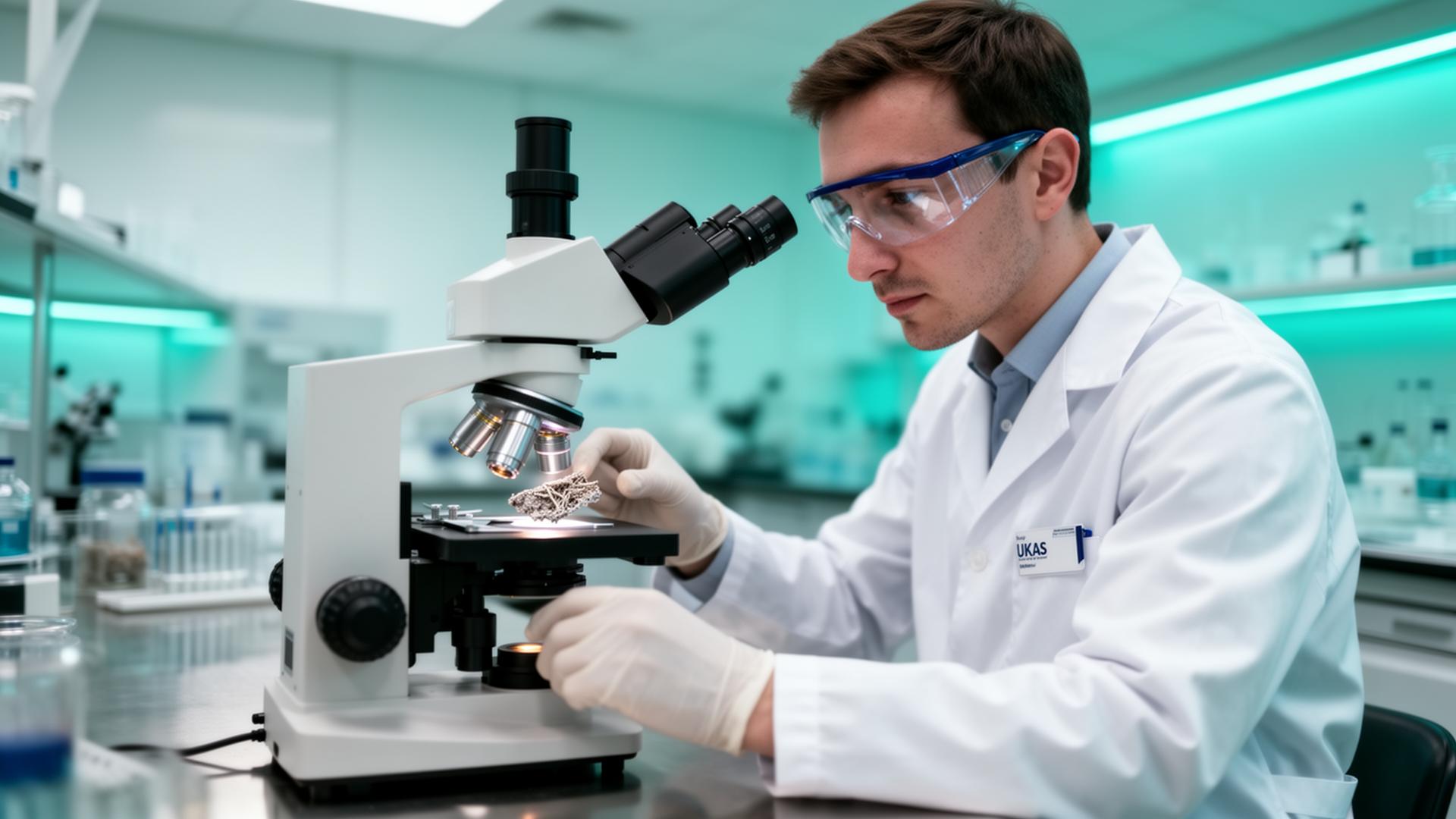
Analysis is by polarised light microscopy with dispersion staining to MDHS 77, the HSE-prescribed UK method. The analyst sub-samples under a stereo microscope, mounts suspect fibres on a slide in dispersion liquid, and examines them under polarised light. Each of the six commercial asbestos minerals (chrysotile, amosite, crocidolite, anthophyllite, tremolite, actinolite) has diagnostic optical properties — refractive index, sign of elongation, pleochroism, extinction angle — that allow positive identification. The method identifies fibres present at concentrations above approximately 0.001%. It does not quantify percentage content — that is not part of MDHS 77 and a bulk sample report that claims a percentage is not following the standard method.
What this means
PLM identifies fibre type. It does not quantify percentage. Reports stating '15% chrysotile' are not following MDHS 77 — be cautious about them.
UKAS 17025 — and why it matters
ISO 17025, awarded by UKAS in the UK, is the international standard for testing and calibration laboratories. It covers competence of staff, equipment calibration, sample handling, method validation, quality control, reporting and audit. A UKAS 17025 accredited asbestos lab has been independently audited against all of these elements and the analyst on the bench has been individually competence-assessed. A 'non-accredited' lab — even one that uses PLM and follows MDHS 77 in good faith — has none of these assurances and the certificate it issues is not accepted by the HSE, by insurers, by most lenders, or by competent surveyors. Always check the lab's UKAS schedule before commissioning sampling.
What this means
If the lab is not on the UKAS schedule, the certificate is not decision-grade. The schedule is public and searchable — check it before you commission.
Cost and turnaround in 2026
Per-sample analysis is £30–£85 at the lab. Our sampling visit is £85 + VAT for one sample, £115 for two, £145 for three, £175 for four, £205 for five and £235 for six, including consultant attendance and analysis. Each further sample during the same attendance is £30 + VAT. Standard lab turnaround is 24–72 hours from receipt; same-day analysis is available at a premium (£85–£120 per sample, results by close of business if delivered to the lab by mid-morning). For multi-sample exercises (refurbishment scoping, several rooms) the per-sample rate falls and the call-out is amortised. Postage from competent persons to the lab is standard practice for bulk samples; the lab provides the appropriate transport packaging.
- •Lab analysis only: £30–£85 per sample
- •Our surveyor visit: one sample £85 + VAT; two samples £115 + VAT
- •Each additional sample at same visit: £30 + VAT
- •Same-day analysis premium: £85–£120 per sample
- •Standard turnaround: 24–72 hours from receipt at lab
What this means
The published sampling schedule includes attendance, collection, UKAS-accredited laboratory analysis and the bulk analysis certificate. It is not an asbestos survey or survey report.
Reading the certificate
A compliant certificate states: the sample reference, the location, the date and time of sampling, the sampler's name and qualification, the analyst's name, the lab's UKAS accreditation number, the method (MDHS 77), the result for that specific sample, and any caveats about sample condition. Results are either a positive identification of one or more fibre types (e.g. 'chrysotile detected') or the phrase 'no asbestos detected'. The result applies to the sample as taken — not necessarily to the whole material if it is heterogeneous. Repeat sampling at multiple locations is standard for large items (full Artex ceiling, multiple AIB ceiling panels) where the material may vary.
What this means
'No asbestos detected' applies to the sample only. On large or heterogeneous materials, one sample is rarely enough — two or three from different points is the proportionate baseline.
Found this guide useful?
Need asbestos sampling surveyed or removed?
Fixed-price written quotes from qualified asbestos consultants across London, Essex, Kent and the surrounding South East — no obligation.
Heterogeneity — the trap people fall into
Materials manufactured in batches, applied in layers, or assembled from multiple sheets can vary in asbestos content from point to point. A textured coating applied over an earlier coat may have asbestos in the lower layer and not in the upper. An Artex ceiling decorated multiple times may have an asbestos base coat under non-asbestos overlays. A vinyl floor may have asbestos in the tile but not the adhesive, or vice versa. A garage roof of mixed-age sheets may have asbestos in some panels and not others. A single sample at a single point can return 'no asbestos detected' while the material as a whole contains it. Competent surveyors take multiple samples at multiple points and at multiple depths.
What this means
Heterogeneity is the single biggest reason real-world sampling exercises return misleading negatives. Multiple samples at multiple points, at multiple depths, is the rule for any significant decision.
Sample types and quantities
Most bulk samples are 5–20g — a piece of material the size of a 50p coin is plenty for PLM. Larger samples are not better and add to disposal cost. The exception is layered materials, where a core sample through the full depth (Forstner bit through textured coating, or core through bitumen-bonded vinyl) is required to capture every layer. The sample is double-bagged in clear polythene, labelled with a tamper-evident seal, and accompanied by a chain-of-custody sheet from sampler to lab.
What this means
Sample size: 5–20g, smaller than people expect. Layered materials need a core, not a chip.
Common mistakes — and how to avoid them
Homeowner takes the sample with bare hands and a kitchen knife; non-competent contractor takes a single sample of an Artex ceiling and declares the whole ceiling clear; sample taken without dampening and without controlled disposal of the offcut; sample sent to a non-UKAS lab; result read in isolation without considering heterogeneity; positive result acted on without checking the regulatory regime (licensed vs non-licensed) for the identified material. Each of these is fixable with a 30-second pause before instruction — but each happens routinely in the market.
What this means
Sampling looks simple. It is not. The cost of a competent sampler is the cheapest insurance you can buy on the decision the result will drive.
What happens after a positive result
A positive identification triggers two decisions: management vs removal, and the regulatory regime for any removal. AIB and lagging are licensed; cement, vinyl and most textured coatings are non-licensed; large or poor-condition cement and textured coatings are NNLW. The sample result is the start of that decision chain, not the end. A good sampling exercise hands the client not just a certificate but a one-page recommendation explaining what the result means and what the proportionate next step is.
What this means
Ask the sampler to include a written recommendation with the certificate. A bare certificate is the start of the conversation, not the whole of it.
Frequently asked questions
Can I take and post a sample myself?
Most UKAS laboratories accept samples from competent persons only and decline DIY submissions. DIY sampling is not recommended because of fibre release risk and because the chain-of-custody requirements are not met.
What does sampling actually cost?
Wholesale lab analysis alone is £30–£85 per sample. Our sampling visit is £85 + VAT for one sample, £115 for two, £145 for three, £175 for four, £205 for five and £235 for six, including consultant attendance and analysis. Each further sample during the same attendance is £30 + VAT.
How long does the result take?
Standard turnaround is 24–72 hours from receipt at the lab. Same-day analysis is available at £85–£120 per sample premium if the sample reaches the lab by mid-morning.
Does the result tell me how much asbestos is in the material?
No. MDHS 77 identifies fibre type, not concentration. Reports that quote a percentage figure are not following the standard UK method.
Is one sample enough for a whole ceiling?
Often no. Materials applied in layers or in batches can vary point to point. Two or three samples at different locations and depths is the proportionate baseline for a significant decision.
What is UKAS 17025 and why does it matter?
It is the international laboratory accreditation standard, awarded in the UK by UKAS. A non-UKAS lab certificate is not accepted by the HSE, by insurers or by competent surveyors. Always check the lab's UKAS schedule.
What does 'no asbestos detected' mean?
No asbestos fibre was identified in that specific sample. The result applies to the sample as taken — not necessarily to the whole material if it is heterogeneous.
Can my builder take the sample?
Only if they hold BOHS P402 and the lab will accept samples from them. Most builders do not. The right pattern is: builder calls in a competent surveyor, sample is taken, result returned, builder works to the result.
What if the result is positive — what do I do next?
Decide between management and removal, then decide the regulatory regime for any removal (licensed for AIB and lagging; NNLW or non-licensed for most cement and textured coatings). A good sampling report includes a written recommendation.
Can I rely on a sample taken five years ago?
Yes for fibre identification — asbestos does not change identity over time. No for condition — the material may have degraded, been damaged or been altered since.
Speak to an independent qualified consultant about your project
Independent asbestos surveying specialists. Evidence-based recommendations, P402-qualified surveyors, coverage across the South East and East of England. Every enquiry is reviewed by a qualified consultant — consultancy before sales, no obligation.
Read next
For this section- Bulk Sample AnalysisThe laboratory side of sampling — what MDHS 77 actually involves under the microscope.
- Management SurveysWhere sampling ends and a full management survey takes over.
- Refurbishment SurveysWhy a refurbishment survey is the right service for any project that disturbs the fabric.
- Asbestos Removal Costs in the UK (2026)What a positive sample result usually leads to — and what that costs in 2026.