
Independent guidance · Core topics
Asbestos Identification Guide
A practical UK guide to identifying asbestos containing materials by appearance, location and building age — and when only laboratory analysis can confirm it.
Key takeaways
- Corrugated asbestos cement (garage roofs, agricultural buildings)
- Asbestos insulating board (AIB) — ceilings, soffits, partitions
- Pipe lagging and boiler insulation
- Artex and textured decorative coatings
- Vinyl floor tiles and black bitumen adhesive
Independent consultancy view. Asbestos was used in over 3,000 building products in the United Kingdom before its full ban in November 1999. Although some materials have a recognisable appearance, visual identification alone is never reliable: many asbestos products look identical to non-asbestos equivalents, and the only definitive method is polarised light microscopy carried out by a UKAS 17025 accredited laboratory. This guide explains the visual cues, the common materials, and the legal framework that governs when identification must be carried out by a competent surveyor.
Why visual identification is unreliable
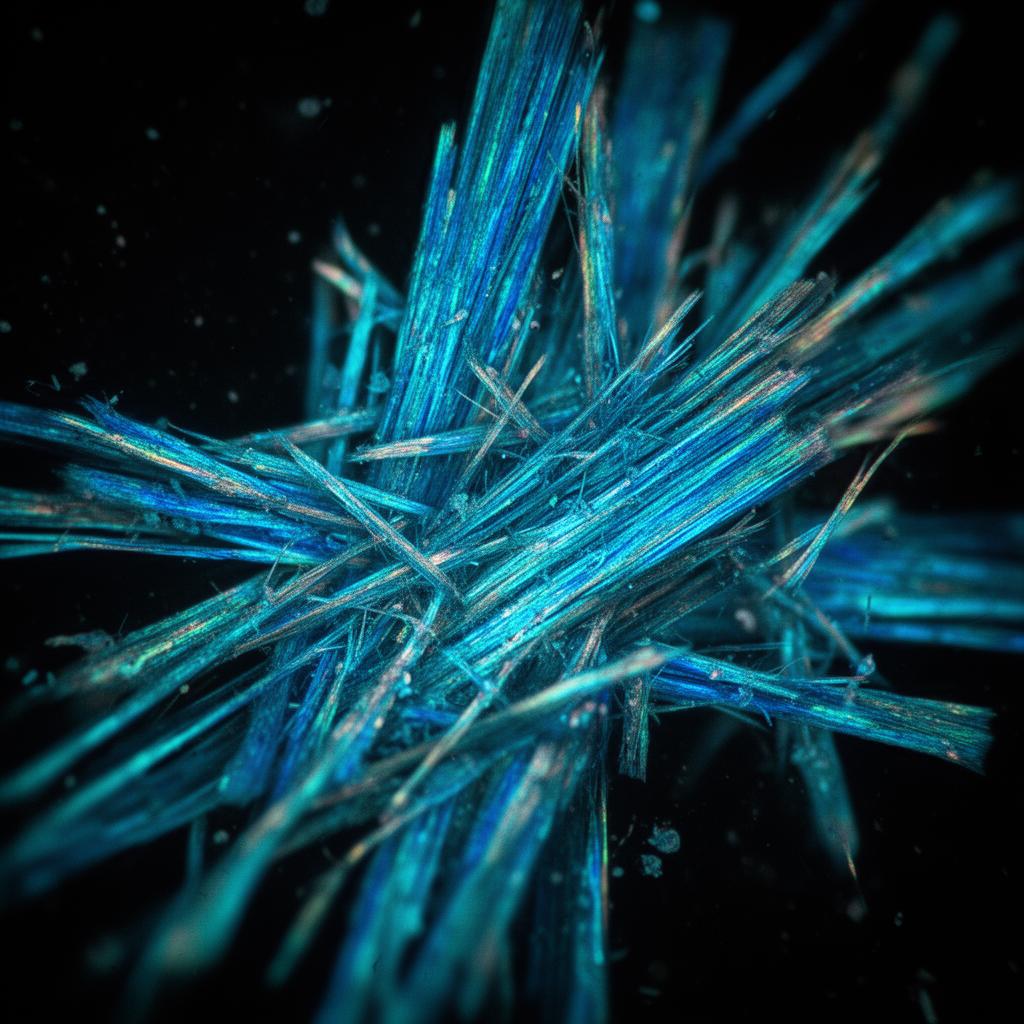
The three asbestos fibre types used commercially in the UK — chrysotile (white), amosite (brown) and crocidolite (blue) — are not visible to the naked eye when bound into building products. Cement boards, vinyl tiles, textured coatings and insulation can all appear visually identical whether or not they contain asbestos. Colour names refer to raw fibre, not the finished product. Any visual judgement must therefore be treated as a suspicion, not a confirmation, and verified by bulk sampling.
What this means
Treat every visual identification as a hypothesis to be tested in the lab, never as a conclusion. The cost of one sample is much smaller than the cost of being wrong.
Building age — the first triage
If a building, extension or refurbishment dates from before 2000 and has not had a refurbishment or demolition survey, asbestos must be assumed to be present until proven otherwise. The Control of Asbestos Regulations 2012 (regulation 4) places this presumption squarely on the dutyholder. Buildings constructed after 2000 are highly unlikely to contain asbestos in original fabric, but later refits with reclaimed materials can introduce it.
What this means
Pre-2000 = assume present. The presumption is legal, not optional, and shifts the burden of proof onto the dutyholder.
Common asbestos containing materials
The materials most frequently identified in UK domestic and commercial surveys are summarised below. Each links to a full guide with photographs, risk rating and management advice.
- •Corrugated asbestos cement (garage roofs, agricultural buildings)
- •Asbestos insulating board (AIB) — ceilings, soffits, partitions
- •Pipe lagging and boiler insulation
- •Artex and textured decorative coatings
- •Vinyl floor tiles and black bitumen adhesive
- •Asbestos cement flue pipes
- •Eaves soffits, fascias and bargeboards
- •Cement cold water storage tanks
What this means
Eight materials account for roughly 90% of what surveyors actually find in UK pre-2000 buildings. Knowing this list narrows the search dramatically.
Fibre types and what they look like
Chrysotile (serpentine, curly fibres) accounts for around 90% of asbestos historically used in the UK and is found in cement products, textured coatings and floor tiles. Amosite (amphibole, straight brown fibres) is associated with AIB and high-fibre-content boards. Crocidolite (amphibole, blue) is the most hazardous and was used in sprayed coatings and some lagging. Fibre identification requires a UKAS 17025 accredited laboratory using PLM analysis to MDHS 77.
What this means
Fibre colour describes the raw mineral, not the finished product. A grey cement sheet can contain any of the three.
Where to look first — the triage walk-through
An experienced surveyor walks a pre-2000 building in a fixed order: roof and external envelope (cement sheets, soffits, fascias, downpipes), plant rooms and service risers (lagging, AIB, gaskets), ceilings (Artex, AIB tiles, sprayed coatings), partitions (AIB, asbestos-cement panels), floors (9-inch tiles, bitumen adhesive), and finally water and heating fittings (cement tanks, flue pipes, boiler insulation). This sequence catches roughly 90% of UK ACMs before any intrusive work begins.
What this means
Work outside-in and top-down. The order is not arbitrary — it follows where ACMs were typically installed in UK construction sequences.
Sampling — how it is actually done
A competent surveyor takes a 10–30 g bulk sample using damped tools, in a sealed double-bagged container, into the substrate to catch every layer. Samples are uniquely numbered, photographed in situ, recorded against a building plan, and dispatched under chain-of-custody to a UKAS 17025 accredited laboratory. Each suspect material should be sampled in at least two locations — single samples can miss patchy distribution, particularly in textured coatings and bitumen adhesives where the asbestos may be in only some batches.
What this means
Two samples per material, not one. The marginal cost is tiny relative to the cost of a false-negative ruling out a material that is in fact present.
What a sample looks like in the lab
A bulk sample is examined under stereo microscopy to isolate fibres, then under polarised light microscopy with dispersion staining to identify the mineral against reference indices. UKAS 17025 laboratories work to MDHS 77, with documented quality control samples in every batch and a written report stating the asbestos type(s) detected, the approximate percentage, and the analytical limit of detection. Results are usually returned within 24 to 72 hours; same-day analysis is available at additional cost.
What this means
Always ask for the UKAS 17025 lab report number on the certificate. It is the audit trail a future dutyholder may rely on decades later.
Found this guide useful?
Need asbestos identification surveyed or removed?
Fixed-price written quotes from qualified asbestos consultants across London, Essex, Kent and the surrounding South East — no obligation.
When a surveyor must be instructed
Any non-domestic building, common parts of leasehold residential buildings, and any pre-2000 property undergoing refurbishment or demolition requires a survey by a competent person — typically holding the BOHS P402 qualification and working under a UKAS 17020 accredited inspection body. Domestic owner-occupiers are not legally obliged to commission a survey but should never disturb suspect materials. Tradespeople have a separate Section 3 duty under the Health and Safety at Work Act to take reasonable care of others, which in practice means refusing to work on unidentified pre-2000 fabric.
What this means
If you are a tradesperson asked to work without a survey on pre-2000 fabric, you are the one carrying the personal legal duty — not just the dutyholder.
False positives, false negatives and why the lab matters
Polarised light microscopy is a mature, accurate analytical method, but it is not infallible. False negatives occur when the analyst examines a homogeneous-looking sample and the asbestos is only in another layer; false positives are rare but can happen when other fibrous minerals (mica, gypsum, tremolite-actinolite contamination of vermiculite) are misidentified. Both error types are minimised by using a UKAS 17025 lab with a documented proficiency-testing record. A laboratory result is only as reliable as the sampling that fed it.
What this means
The weakest link in identification is usually the sample, not the laboratory. Pay attention to who takes the sample, not just who tests it.
Photographic identification — useful, but not a substitute
Photo libraries (HSE's Asbestos Image Gallery, our own Identification Centre, contractor knowledge bases) help triage what to sample and what to ignore. They cannot identify with certainty: post-1999 fibre-cement, modern non-asbestos AIB substitutes (Masterboard), polymer-modified textured plasters and synthetic gaskets often look indistinguishable from their asbestos predecessors. Use photo libraries to narrow the search; use the laboratory to close it.
What this means
Photos are a fast filter, not a verdict. The verdict comes from PLM under MDHS 77.
What to do once a positive result lands
The next step depends on condition and disturbance risk, not on the mere presence of asbestos. Intact, undamaged material in a stable location is usually managed in situ — labelled, recorded on the asbestos register, included in a written management plan and reinspected annually. Damaged material, material in high-disturbance areas, and material that will be affected by planned works is removed by an appropriately qualified contractor: HSE-licensed for AIB/lagging/sprays; NNLW or non-licensed for cement and most textured coatings.
What this means
A positive identification is not an emergency — it is a trigger to choose between management and removal, based on condition and planned disturbance.
Frequently asked questions
Can asbestos be identified visually?
Suspicion can be raised visually, but identification can only be confirmed by laboratory analysis. Many materials look identical with or without asbestos.
Is white asbestos safe?
No. Chrysotile (white asbestos) is a Group 1 carcinogen and is subject to the same legal duties as amosite and crocidolite. The colour does not indicate safety.
How much does asbestos testing cost?
Bulk sampling is £60 + VAT for the first sample and £30 + VAT for each additional sample on the same visit. Management survey guide prices start from £160 + VAT for flat communal areas, £200 + VAT for flats and £250 + VAT for houses; commercial premises are quoted after a scoping call.
How long does laboratory analysis take?
Standard turnaround is 24–72 hours. Same-day analysis is available from most UKAS accredited laboratories at additional cost.
What qualifies someone to take an asbestos sample?
In practice, the BOHS P402 qualification (Building Surveys and Bulk Sampling for Asbestos) is the UK industry standard. Sampling without it is legal but the result carries little evidential weight in court or insurance disputes.
Is asbestos testing a DIY job?
Home test kits exist but the sampling is the risky step — and untrained sampling is the most common cause of fibre release in UK domestic settings. A small fee for a competent surveyor avoids the exposure risk and produces a UKAS-traceable result.
How many samples does a typical management survey take?
A management survey of a small UK commercial unit typically takes 6–15 samples; a larger office or school can run to 40–80. The number depends on the variety of materials, not just floor area.
Can asbestos be identified after it has been removed?
Yes — residue, dust and waste material can all be analysed. If you suspect a previous contractor disturbed asbestos without testing, a competent surveyor can take dust samples and report against the asbestos clearance threshold.
What if the lab finds 'trace' asbestos?
Trace findings (below the standard 0.001% reporting limit) are still legally asbestos under CAR 2012. Treat trace results as positive for management purposes and consult the surveyor on the practical implications.
Does identification need to be repeated over time?
The material does not change, but its condition does. Management surveys are reinspected annually under HSG264; previously identified materials are re-rated for condition, not re-sampled.
Speak to an independent qualified consultant about your project
Independent asbestos surveying specialists. Evidence-based recommendations, P402-qualified surveyors, coverage across the South East and East of England. Every enquiry is reviewed by a qualified consultant — consultancy before sales, no obligation.
Read next
- Asbestos SamplingThe how-to companion to this guide — sample size, container, chain-of-custody and lab dispatch.
- Bulk Sample AnalysisWhat happens to your sample inside the UKAS 17025 lab — PLM, dispersion staining, MDHS 77.
- Management SurveysThe standard non-intrusive survey type used to identify ACMs in occupied buildings.
- Refurbishment SurveysThe intrusive survey required before any work that may disturb pre-2000 fabric.
- Asbestos Cement GuidePhotos, percentages and identification cues for the single most common ACM in UK buildings.
- Asbestos Insulating Board (AIB) GuideHow to tell AIB from cement and modern non-asbestos board — the most consequential identification call.